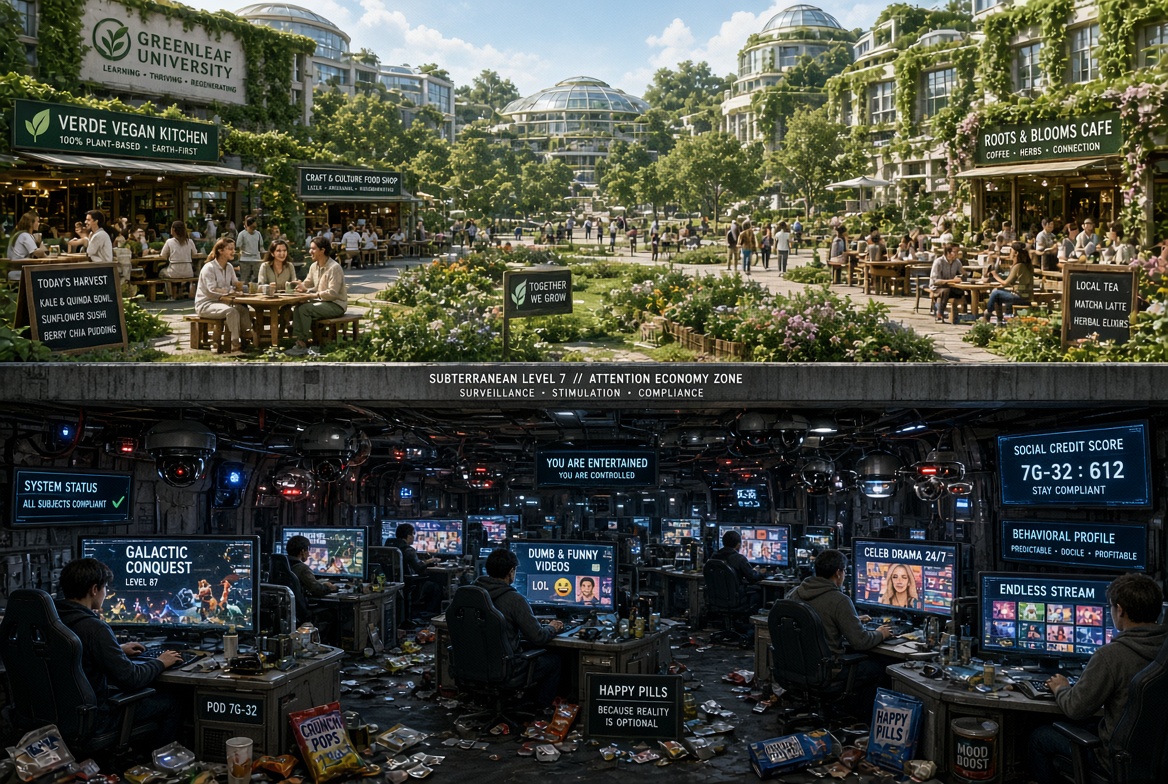
There have always been two contrasting visions of a kinder and fairer society, whether we call it communism, socialism, social democracy, communalism, anarcho-communism or libertarian socialism. One assumes a vanguard party will guide the underclasses towards a new civilisation, while the other believes only the oppressed classes can emancipate themselves through a grassroots struggle against the concentration of power. In other words, one seeks to replace the old oligarchy with a new progressive technocracy, while the other seeks to depose all elites. Both revolutionary Marxism and Fabianism take the Hobbesian view of humanity as mere savages without the oversight of the enlightened managerial classes. By contrast, grassroots socialists take the Rousseauvian view of humanity: that men and women will independently build fairer societies without class hierarchies or bureaucracy, if only the corrupting machinery of power is dismantled.
Both visions suffer from fatal oversights. The Rousseauvian dream ignores the fallen nature of man, imagining an inherent innocence that historical reality repeatedly shatters. The Hobbesian-managerial path leads directly to the totalitarian slaughterhouses of the twentieth century and the soft, suffocating technocracies of the twenty-first.
We are, by nature, a social species. We have evolved from the compact, face-to-face societies of our ancient forebears to the sprawling, hyper-complex systems we inhabit today, opening a vast accountability gap. The development of language enabled mankind to share abstract ideas, codify duties and coordinate across kin networks, subduing the wilderness and building civilisations.
Small communities thrived because human scale kept power in check. Everyone knew everyone else. Social bonds, reputation and cooperative obligations were paramount. Survival depended on reciprocal generosity, shared hardship, physical courage and organic coalition-building. People earned prestige through tangible contributions: provision, defence, storytelling and wisdom. Abusive or parasitic tribesmen or women could be held to account, exiled or brought to heel by the community.
As societies transitioned to agrarian settlements, communities expanded and surpluses accumulated. Greater social stratification emerged with the rise of formal land tenure and serfdom. Redistribution and patron-client obligations served to legitimise rule by the few over the many, while religious rites, ancestral ties and dynastic alliances solidified social order. The trade-off was visible hierarchy, which created both dependence and resentment, yet preserved civilisational continuity across generations.
The rise of early states and feudal kingdoms formalised these hierarchies through legal codes, military oaths and spiritual authority. Legitimacy rested on lineage, sacred duty and control of the means of force. While social mobility was constrained, social duty was reciprocal: the lord was bound to protect and administer justice to the people who worked the land.
Pre-industrial market towns and urban centres thrived on specialised skills, apprenticeship networks and the high-trust requirements of craftsmanship. Across various civilisations, this created a baseline of local trade ethics where reputation and mutual accountability functioned as the primary regulators of conduct. Within these homogeneous groups, the artisan or merchant who cheated his community risked social and economic exile.
However, we must strip away any romanticism regarding this era. While these local networks nurtured a skilled and productive population, they existed under the shadow of a predatory ruling class that viewed human beings as mere assets to be deployed. The same European powers that cultivated a sophisticated skills base were simultaneously building systems, often bankrolled by early financial cartels, that treated human life as expendable. The brutal reality of the slave trade and the ruthless exploitation of the domestic working class during the early industrial era reveal that the ruling elite never shared the moral constraints of the people they governed. They operated in a sphere of power where human capital was merely a ledger item to be liquidated for geopolitical and financial gain.
The historic success of European nations was not a product of this elite exploitation; rather, it was a triumph of the common people, who built a thriving, resilient skills base in spite of these extractive forces. The wealth of these nations was generated by the generations of craftsmen, farmers and skilled labourers, without whom the mercantile classes could not have set sail to colonise new lands.
The tragic ongoing pattern is that the elite often leveraged the productivity and national cohesion of these populations to fund colonial, mercantile or financial projects that ultimately served to weaken the very foundations of their society. We are seeing this pattern reach its zenith today. The managerial classes do not just ignore the working class. They actively cannibalise the remnants of that productive base, replacing organic, skilled autonomy with a hollowed-out surveillance economy where the majority are expected to be passive and interchangeable components of a global grid.
The transition to the industrial era merely accelerated this divide. It stripped the working class of the ability to enforce local norms of fairness, replacing the personal patron or the master craftsman with the impersonal, distant logic of the corporation and the state. Today, that distance has become absolute. We are governed by a class that has fully immunised itself from the consequences of its own policies, preaching a form of enforced social equality to the populace while operating within a private, globalised sphere of influence that ignores all the traditional ethical boundaries that once kept power in check.
The cybernetic platform economy transformed attention itself into the primary resource. Digital platforms could elevate a single voice into a mass event overnight, yet they also rationed visibility through opaque algorithms. The surest path to prominence was calculated outrage or weaponised vulnerability, pitched to populations stripped of genuine community and desperate for connection. Control remained in the hands of the algorithmic architects, leaving social trust hollowed out.
Today’s surveillance economy has hardened these dynamics into systemic social control. It rewards behavioural predictability, compliance and digital conformity. Status now depends entirely on access to elite gatekeepers and fidelity to approved narratives, while individual autonomy, economic independence and genuine dissent are methodically erased.
Looking forward, this landscape demands a reckoning. The managerial elite promises safety, equity and liberation through digital IDs, corporate collectivism and managed decline. Many individuals respond by developing multiple personas, curating their digital footprints and learning algorithmic compliance simply to survive. Yet this fragmented existence exacts a devastating toll on human sanity and genuine fellowship.
What about the Underclasses?
Collectivists have long tried to persuade the vulnerable and disadvantaged that only larger institutions can protect them from the injustices of an unbridled free market which, if left unregulated, supposedly amplifies deep-seated prejudices against the physically, mentally, or economically inferior.
Paradoxically, collectivism has historically fuelled the very kind of rigid stratification and atomisation that social progressives claim to oppose. Yet, as human nature demonstrates, social competitiveness is an inescapable reality, visible nowhere more clearly than in our mating and social bonding strategies. Fluid, deregulated sexual markets amplify this competition, driving a modern hypergamy where a vast majority of young women chase a small elite of high-status, affluent males, leaving a swelling underclass of sub-alpha men entirely sidelined. In the real world of the struggling household, domestic stability shatters not merely from abstract ideological disputes, but from the brutal pressure of financial inadequacy, when a man can no longer provide the lifestyle to which peer pressure and media role models have taught his partner to feel entitled, precipitating alienation, recrimination and the dissolution of the family unit.
Progressive technocracy exploits this natural Darwinian ruthlessness under the banner of egalitarianism. Many observers in the alternative media sphere, from anarchists to social conservatives, have long argued that this elite is committed to an immediate, radical depopulation agenda. But this view often relies on an ahistorical reading of population growth. We have been conditioned to view our current state, over 8 billion people, as a linear trajectory of modern medicine and industrial expansion. In reality, history shows a more checkered past: from the fluctuations of the agrarian ages to the more complex, higher-density reality of pre-colonial Africa, population has always been a reflection of social stability and environmental capacity.
The elite is not planning a single, sudden culling. That is a cinematic fantasy that ignores the inertia of the modern system. Instead, they are playing a generational long game. They intend to phase out the redundant masses gradually, corralling them into a digital control grid where the illusion of diversity and inclusion masks total administrative capture.
In this managed decline, psychiatrisation plays a critical role. Human friction, despair born of rootlessness and the natural resistance of freeborn men to subjugation are systematically pathologised. Dissidents or the malcontents are not punished politically. They are diagnosed, medicated and managed.
For the core populations of the West, the ultimate vision mirrors a twisted inversion of Aaron Bastani’s Fully Automated Luxury Communism: a two-tiered future. On one tier, the managerial and technocratic elite enjoy an abundance of automated luxury, personal robotics and boundless consumption, a lifestyle that is, in itself, a testament to the fact that our current debt-driven, high-consumption model is being transitioned, not destroyed. On the other tier, the disempowered precariat is warehoused in micro-apartments, pacified by digital soma in the form of streamed entertainment, video games and processed ready-meals and kept alive through corporate largesse and universal basic pittance. Stripped of bargaining power, property and purpose, they are endlessly monitored, categorised and micro-managed. Meanwhile, in regions deemed non-essential to the high-tech core, such as parts of Africa, the strategy shifts from containment to neglect and engineered internecine conflict, allowing regional demographic pressures to resolve themselves away from the gaze of the metropolitan centres.
Classless equality remains an impossible phantom because human beings are neither biologically identical nor infinitely malleable. The affluent managerial class cultivates a phantasy of a technocratic utopia: a borderless world of woke globe trotters and high-speed transit, all sustained by eco-friendly innovation and the boundless opportunities of globalisation. They imagine a future where the entire planet is a network of research campuses, plush enclaves and pristine nature reserves.
Yet this utopia has no room for the unassimilable. It requires that the angry natives and the disillusioned masses fade into the background. To keep the landscape orderly, the elite may preserve certain remnants of the past as living museums. They might cordon off a quaint 18th-century English village or a bustling 17th-century Hanseatic port to serve as cultural exhibits, much like the Maasai Mara in Kenya, where the descendants of once-sovereign peoples are turned into static features of a picturesque, managed environment.
Because simply discarding the masses runs counter to the hollowed-out legalism of liberal democracy, the system instead disempowers them. It reduces them to permanent dependants on welfare plantations and phases them out gradually. The goal is not the uplift of the common man, but his managed obsolescence within a world he is no longer permitted to shape. Under this regime, the only permitted form of heritage is the one that has been stripped of its lifeblood, neatly categorised and made safe for the masters of the fourth industrial revolution.
From a young idealist to a lifelong critical thinker
I grew up in a staunchly Labour family and as a teenager joined the Neo-Trotskyite Socialist Workers Party, in part to rebel against the condescending hypocrisy of the bourgeois managerial classes who dominated the establishment left. I had always been culturally of the left, at least as we understood the concept in the 1970s and 80s: the struggle of honest, hardworking men and women against predatory capital, and the defense of national self-determination against imperial overreach. I had read the Communist Manifesto and Che Guevara’s Guerrilla Warfare by the age of sixteen.
Yet I was too independent a thinker to stay submerged in groupthink for long. I had naively imagined that a socialist revolution would liberate the eccentrics, the bullied and the alienated. It did not take long to realise that the petty psychological bullying, status-seeking and conformity enforced by party comrades were identical to the cruelties of the school playground, just cloaked in high-minded dialectical jargon.
The traditional left-right divide has been emptied of its historical meaning. The modern institutional left has long since abandoned the industrial working man. In Western nations, it has morphed into a managerial coalition of the ultra-wealthy, technocrats and credentialed professionals, backed by heavily subsidised client groups.
The elite relies on the psychology of the marginalised to exercises its control. An individual who feels rejected by traditional social structures, whether due to personal eccentricity, perceived inadequacy or social alienation, carries a deep grievance against the organic order. Recognising this, the managerial regime weaponises that grievance. It manufactures identity categories, convincing atomised individuals that their personal unhappiness stems from historical oppression, the nuclear family, the historic nation or even traditional faiths.
By defining identity through victimhood, the regime provides the wounded ego with two intoxicating drugs: moral superiority and artificial belonging. The marginalised soul, desperate for recognition, finds a surrogate family in the activist cell, the HR committee or the online mob.
Yet this inclusion is contingent. The regime grants status only in exchange for ideological submission. The marginalised become an instrument of destruction against the regime’s real enemies: independent smallholders, self-reliant families, traditional local institutions and moral frameworks that together curb the overreach of power.
When the revolutionary dust settles, the marginalised find they have exchanged a world with natural, reciprocal duties for a cold digital panopticon run by the very corporate and bureaucratic oligarchy they thought they were resisting. The elite provides therapeutic platitudes and welfare scraps to keep the underclass passive, while systematically dismantling their capacity to live as free, independent, self-governing people.
We do not have to accept the managed obsolescence of the masses. The current technocratic nightmare relies on our belief that we cannot survive without its global grid. But real social solidarity is not born from bureaucratic mandates or abstract egalitarianism. It exists in the natural, organic bonds of family, faith, ancestral heritage and honest productive labour. We cannot prevent extreme power concentration through a more progressive technocracy based on fantasies of a borderless and hierarchy-free commune. Instead we need to rebuild local sovereignty, productive independence and unyielding allegiance to natural humanity. If we can break the centralised control of technology and organise around communities that respect the true nature of man, we may find that our potential for community and excellence is far greater than the management we have been told is inevitable.